
Medicare & insurance help
Health insurance terms, explained in plain language
A practical glossary of premiums, deductibles, copays, networks, formularies, and other common insurance terms.
Understanding a few common terms makes it easier to compare coverage and ask useful questions. These definitions explain the concepts; the details depend on your policy.
The costs you may pay
- Premium
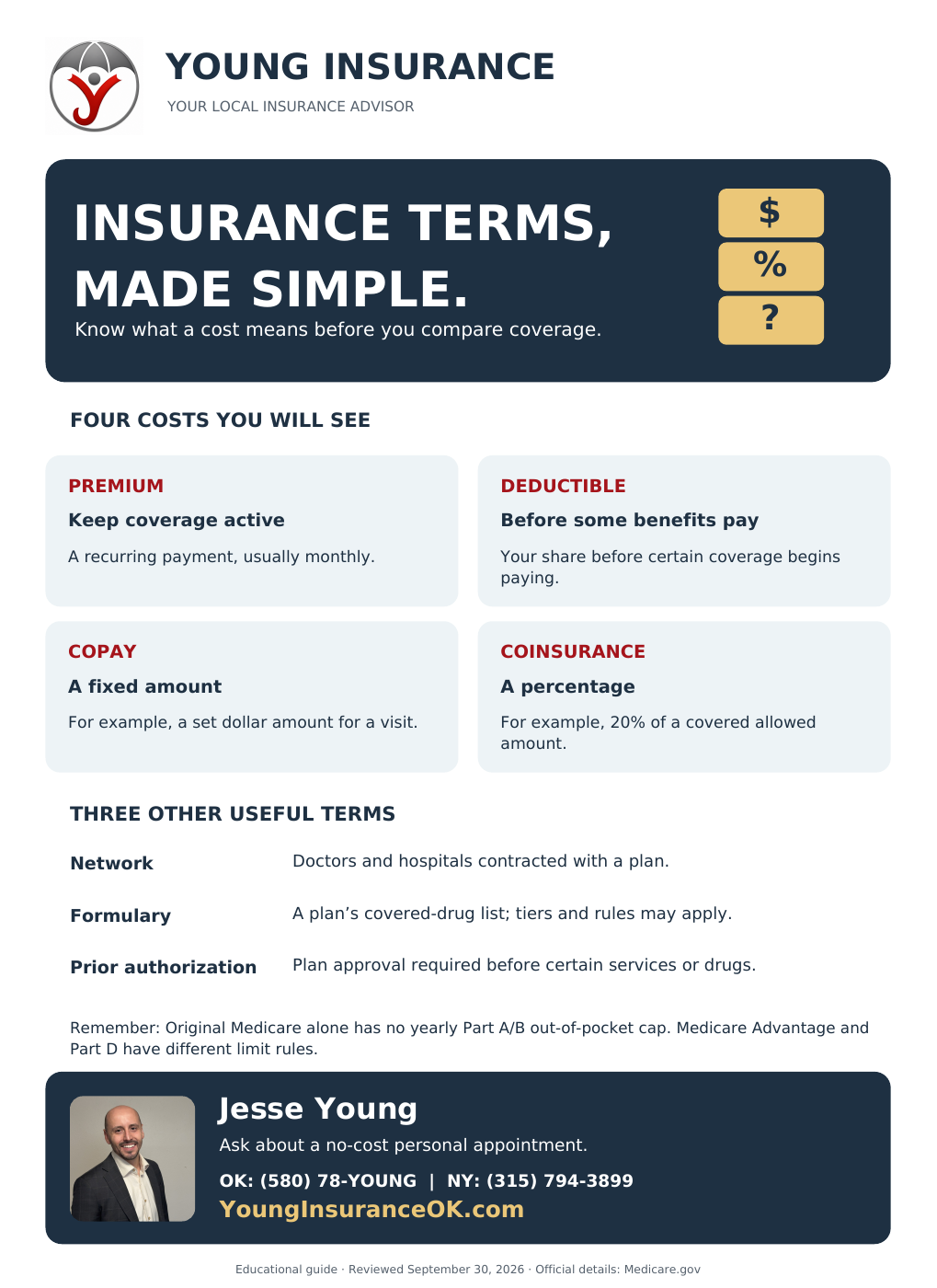
- The recurring amount you pay to keep insurance active, usually each month. You can owe it even when you do not use care.
- Deductible
- An amount you pay for certain covered services before the coverage begins paying its share. Some services may be covered before you meet it.
- Copayment, or copay
- A fixed amount for a covered service or prescription, such as $20 for a visit.
- Coinsurance
- Your percentage of a covered cost. If the allowed amount is $100 and your share is 20%, your coinsurance is $20.
- Out-of-pocket maximum
- A limit on certain covered costs during a plan year. Premiums and non-covered services generally do not count. Medical and prescription limits can work differently.
Medicare distinction: Original Medicare alone has no yearly cap on your Part A and Part B out-of-pocket spending. Medicare Advantage has a limit for covered Part A and Part B services. Part D prescription costs have separate rules.
The people and places providing care
- Network
- The doctors, hospitals, and other providers contracted with an insurance plan. Check the exact plan, not just the insurance company’s name.
- In-network / out-of-network
- Whether a provider participates in that network. Out-of-network care may cost more or may not be covered, depending on the plan and situation.
- Primary care provider
- A clinician who handles routine care and helps coordinate other services.
- Referral
- A direction or order from a provider to see another provider or receive certain services. Some plans require it.
Coverage and paperwork
- Formulary
- The list of drugs a plan covers. Drug tiers, pharmacy choices, and restrictions can affect cost and access.
- Prior authorization
- Approval a plan may require before certain services or drugs. Approval requirements are different from a referral.
- Explanation of Benefits (EOB)
- A statement explaining how an insurance claim was processed. It is not a bill. Compare it with any bill you receive.
- Preventive service
- Care intended to help prevent illness or detect a problem early. Cost sharing depends on the service, coverage rules, and provider.
- Open enrollment
- A defined time to enroll or change coverage. Medicare, Medigap, employer insurance, and Marketplace plans have different enrollment rules.
When a term is unclear, ask how it applies to your specific plan and service. Jesse Young can help you turn insurance language into practical questions.