
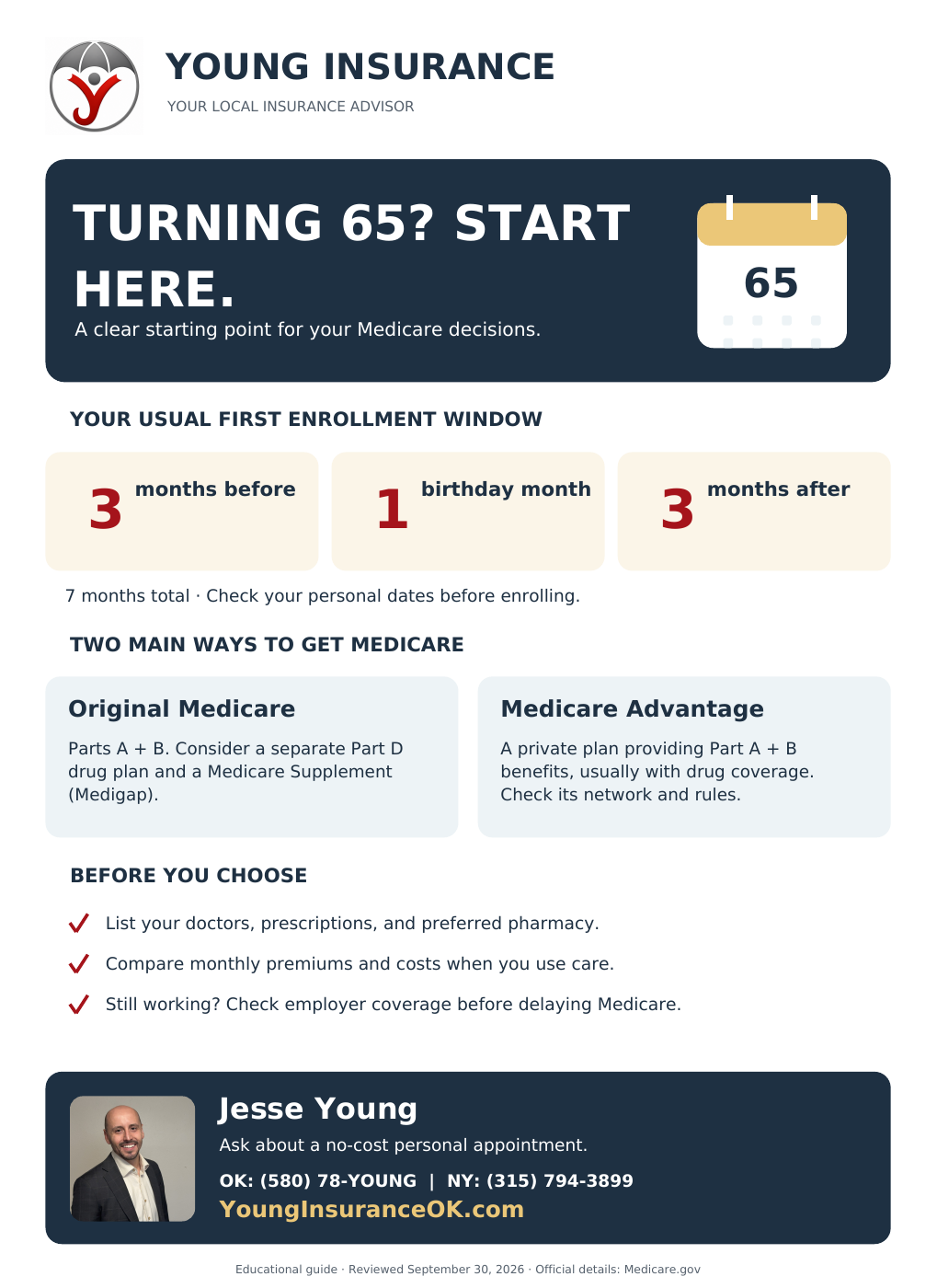
Turning 65? Your Medicare starting guide
Get familiar with Medicare, your first enrollment window, and the questions to ask before choosing coverage.
Turning 65 brings a new set of health insurance decisions. Whether you are retiring, still working, or already receiving Social Security, a little preparation can help you understand your choices before you enroll.
Start with your enrollment timing
For most people turning 65, the Initial Enrollment Period spans seven months: the three months before your birthday month, your birthday month, and the three months after. Your coverage start date depends on when you enroll. People whose birthday is on the first of the month have a different timing rule, so check your personal dates.
Some people are enrolled automatically; others must apply through Social Security. Confirm your status rather than assuming a Medicare card will arrive.
Still working? Check your current coverage
Insurance through your or your spouse’s current employment may affect when you need Part B. Employer size and how the coverage coordinates with Medicare matter. COBRA and retiree coverage are not the same as coverage based on current employment. Ask the employer benefits administrator before delaying Medicare or canceling existing coverage. If you contribute to an HSA, ask about how Medicare enrollment affects those contributions.
Understand your coverage choices
- Original Medicare: Part A and Part B. You may add a separate Part D prescription drug plan and consider Medicare Supplement Insurance, called Medigap.
- Medicare Advantage: Another way to receive Medicare benefits through a private plan. Review its doctors, hospitals, drug coverage, costs, and rules.
Medigap and Medicare Advantage serve different roles. Medigap helps with certain Original Medicare costs; it does not supplement an Advantage plan.
Keep your Medigap window in mind
Your federal six-month Medigap open enrollment window begins the first month you are 65 or older and enrolled in Part B. During this window, an insurer cannot deny a policy because of pre-existing health problems. Additional state protections or guaranteed-issue rights may apply outside that window.
Your getting-started checklist
- Confirm enrollment and coverage start dates.
- List your doctors, hospitals, medicines, and pharmacy.
- Review your current insurance and retirement plans.
- Compare premiums and the costs of using care.
- Ask about prescription coverage even if you take no medicines now.
You do not have to solve every question at once. Bring your list to a personal appointment with Jesse Young, and work through the next steps.